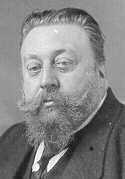
Jan
Frans Simons was born the night of 4 to 5 september
1855 in Antwerp. He was the youngest descendant of
four children in the Simons family. After three
girls, a son was more than welcome. His parents,
grain dealers, were at that time living on the
Aardendijk nr. 65, which in the early years was near
the Oude Leeuwenrui and the storehouses of Saint-Felix.
When Jan Frans Simons was a
teenager, he always wanted to draw. Though the Simons
father wanted his son to become a salesman, the young
fellow dreamed of being an artist. After a few grain-
and fruit deals, his parents took over a brewery in
Brasschaat. When his father died, Jan Frans Simons
had to run this industry on his own. The buildings
were sold when Simons started building a new house on
the Bredabaan, Villa Simons - Villa
Rubens,
nr. 570 for this moment, district of Driehoek.
For short,
the house served as a hotel restaurant De
Notelaar.
Since october 1997, the buildings do not only have
the new name Lucullus, but they also got a new purpose.
The new owner, restaurateur, now uses the buildings
as drawing- and festivity rooms.
In 1879, the 24 year old
artist made his debut on an exposition in Antwerp
with Jo, her darling, a painting which represents a
young farmer's wife, who's bringing her calf
something to drink. It got some bitter critics but it
also received some very deserving compliments. Jan
Frans Simons is well known because of his difference
in folk scenes. There's a variation in paintings like
The Ox races, The Work accident, A Holy day
Procession in Brasschaat, The Swine slaughter and The
Congolese. His works also contain a triptych, in wich
he presents The Wild, The
Civilized
and The
Animals.
There are many different paintings and pictures in public
possession.
Simons was not only
painting Ox races and Holy day Processions, he also
was a very excellent portrait painter. The inventory
list of portraits of notabilities and aristocrats, as
there are doctors and lawyers, high magistrates and
army officers, mayors and senators, children of all
ages, nobly born and not nobly born ladies, is too
complicated to mention completely. Even King Albert I
once came to model in Antwerp for his portrait
sitting on a horse. Frans Simons was a well-bred but
also a loyal and social citizen, straightforward and
candid in company, who never doubted to give his
fellow-man a hand.
World War I, was a
miserable time for the cheerful artist. His health
became affected because of a three month stay in
prison under German occupation. He received a
condemnation to pay a penance of thousand marks. The
German domination disliked the battle scene 'His dying
eye still recognized me', because there were German
peg helmets painted. Though, they left the painting
untouched.
After the trials and
privations from World War I, Jan Frans Simons died in
Brasschaat on the 21 of February 1919. Ever since he
rests in peace in the cemetery of
Brasschaat - Maria-ter-Heide.
His wife and three daughters were also buried in the
family ground.
An illustrated biography of this artist, only written
in Dutch, is published and a couple of his works are
available in a series of 6 postcards, both of them by
the Jan Frans Simons society.
Photogallery:
Alley -
Amorous couple -
Anniversary -
Belle epoque lady -
Cargo-boat in the port -
Christ -
Clementina Ritschie -
Communicante -
Corn flowers -
Country-woman -
Cow guardian -
Cow on the heathland -
Creek -
Creek -
Farm at Eppeghem -
Farm Ballemans -
Farm 'den Elshout' -
Farmers family -
Flirt -
Girl with hooded coat -
Girl with hooded coat -
House Delphine -
Katjeskelder -
Landscape of the 'Kempen' -
Landscape of the 'Kempen' -
Mother De Mont -
Old Antwerp -
Pigeons -
Port of Antwerp -
Portrait of a lady -
Rural burial -
Small flag hangs out it's village fair -
Still life -
Summer landscape -
Sunset on the heathland -
The great road on a winter day -
Tilla Simons -
Two friends -
Visibility of a farm -
Winter landscape -
Winter visibility -
Young farmers couple